Humans appear to rely heavily on hierarchical structures for decision-making, especially for complex tasks (e.g., planning a route from work to home, navigating traffic, etc). Despite the fact that any plan is physically realizable as a sequence of refined actions (e.g., walking to the office door, opening the door, walking down the hallway, etc), most humans do not plan at this low level set of actions. Instead, planning is achieved using a variety of abstraction levels, by aggregating the sequence of actions into high level macro-actions (i.e., exiting the office building, changing lanes in traffic, etc), and by executing this sequence of high level actions by refining them down. This is done because acquiring perfect knowledge about the environment is often prohibitive, and hence acting on the right level of granularity of pertinent information is imperative in order to operate in dynamic and uncertain environments.
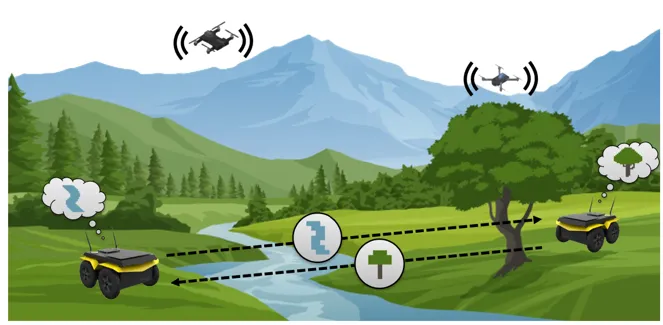 A heterogeneous team sharing what each member knows. Rather than transmitting whole maps, the agents exchange only the pieces of the environment the others need.
Although complete knowledge of the environment is necessary to plan an optimal solution for a given task, the information about the world in which a planning agent is to plan is rarely entirely known. More likely, the agent has only a glimpse of the world abstracted away from the current state and time. This idea has led many researchers to wonder how to abstract the search space in an efficient and meaningful way. Since the early days of AI, a hierarchical abstraction of a transition system has been recognized as a crucial tool for planning in complex environments and long decision horizons.
To reduce the search space and to formulate an innate perception-action loop, we use multi-resolution graph to plan. We construct fine resolution graph near the agent to accurately represent the environment in the vicinity of the agent, and coarser resolution far-away of the agent to reduce the search space. Inevitably, this multi-resolution framework may abstract some crucial information far-away from the agent, and consequently the solution quality can degrade.
But what if our agent is allowed to use other agents’ finer information and vice versa to cooperatively find a better solution? If so, what would be an efficient way to communicate the information among the agents? We try to answer these questions with a distributed search algorithm. We approach this problem by refining each agent’s abstract path using the information provided by the other agents, as distributed local information provides a better heuristic to refine multi-resolution paths of agents.
The main idea is to restrict communication among the agents to just the problem-specific information needed to refine each agent’s abstract graph along the search. In this approach, the agents communicate only the expansion result of A* to locally rewire, and hence all agents attain a common subgraph that includes a provably optimal path in the most informative graph available among all agents if one exists, without necessarily communicating the entire graph. The solution quality and the speeds up from abstraction is balanced efficiently by using multiple agents distributed in the search space, as they communicate only the expansion result of A* to avoid unnecessary communication.
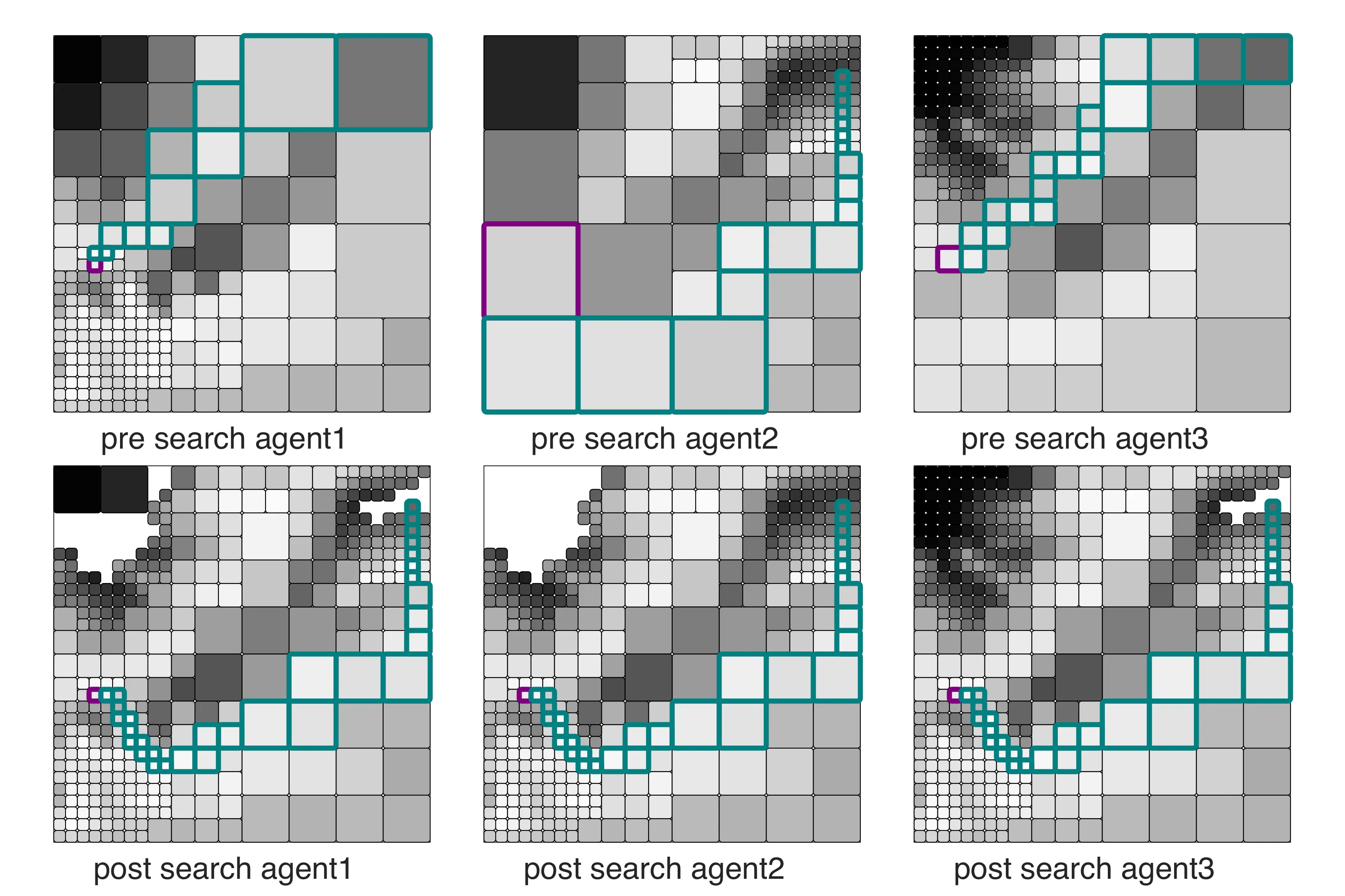 Three agents before (top) and after (bottom) exchanging expansion results. Each begins with detail only near itself; afterwards all three share the same refined subgraph, without any agent having transmitted its whole graph.
We use the idea of “bounded rationality” to capture another aspect of the cognitive heterogeneity in a group. Humans, most of time, are not fully rational. With the limited amount of time given and the limited computational power of a human brain, we tend to make decisions that are “good enough”, instead of finding the decisions that are globally optimal.
In reality, not just humans, many of the autonomous agents also have limitations on computational capacity, available information and computational time and thus cannot be fully rational. To find the optimal strategy in a game that involves agents that are not fully rational, we need to first model such agents. Much of the literature uses the concept of bounded rationality to describe such computational limitations/constraints that the agents face. So, is there a way to model such “irrational” decision makers?
We adopt the level-k thinking framework from the behavioral game theory literature to model the agents of bounded rationality. In the level-k framework, the level-0 agents are first defined with some naïve strategies. Then the level-1 agents best respond to their level-0 opponents, and the level-2 agents best respond to their level-1 opponents, and so on. By adopting this framework, we can put a bound on the maximum level that an agent can go for, and these agents are thus of bounded rationality.
We tested the framework on a discretized pursuit-evasion game over a 16 × 16 grid world with stochastic wind fields, in which the pursuer and the evader start from fixed cells at opposite ends of the grid. An evasion is successful when the evader reaches one of two evasion states; the black cells are obstacles, and an agent that enters one is considered crashed and loses the game immediately. The following sample trajectory illustrates how the level-k thinking framework functions in our PEG.
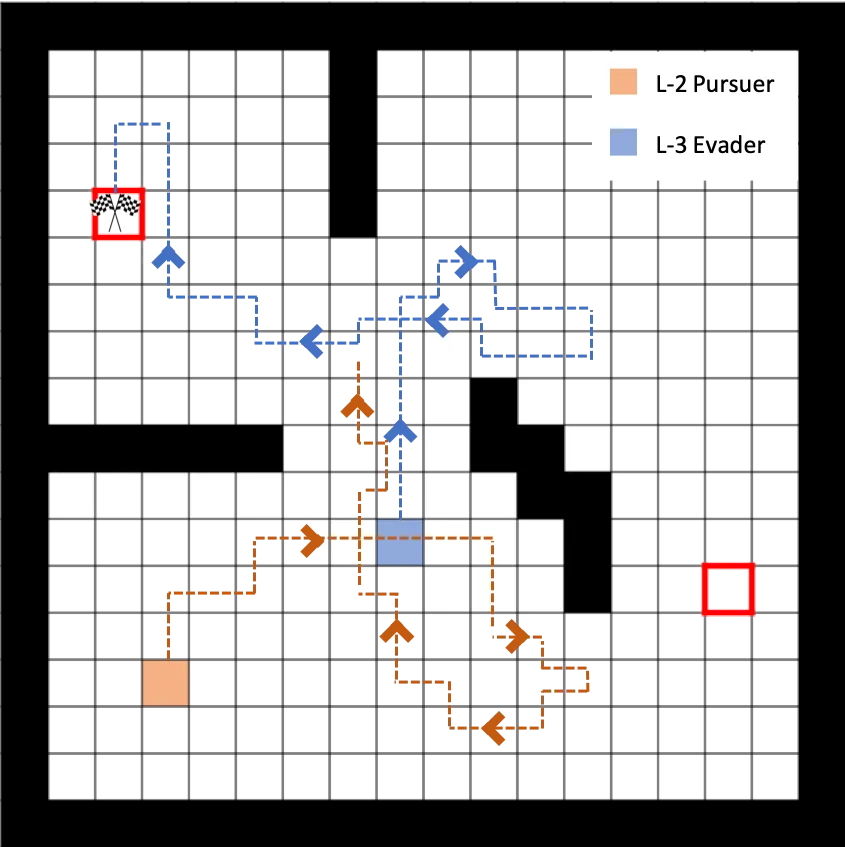 A level-2 pursuer against a level-3 evader. The evader feints right, drawing the pursuer across to defend evasion state #2, then turns left and escapes through evasion state #1.
In the sample trajectory presented is a PEG between a level-2 pursuer and a level-3 evader, and the evader evades in evasion-state #1. One can observe the “deceiving” behavior of the evader: the level-3 evader out-smarts its level-2 opponent by first heading right and then suddenly turning left. This move tricks the level-2 pursuer to believe that the intention of the evader is to go to the evasion-state #2 on the right. As a result, the level-2 pursuer goes right and takes the “short cut” beneath the obstacles to defend the evasion-state #2. Then, the evader suddenly turns left and go to the evasion-state #1 on the left. At the time when the evader reveals its true intention to go to evasion-state #1, the distance between the evader and the pursuer is already large and the chance of the pursuer capturing the evader is significantly decreased. This sample trajectory demonstrates how an autonomous agent would respond, if it takes the bounded rationality of its opponent into account while computing its strategy.
Sponsors
This project is funded by ARL.
External Links