Most problems of interest to the US Space Force and to AFRL involve systems with strong nonlinear effects — orbital motion, rigid-body dynamics and kinematics — and it is precisely those nonlinearities that make uncertainty hard to propagate and harder to mitigate. Such effects are, however, best described by equations that evolve natively on Lie groups, which hypercomplex numbers coordinatize compactly and elegantly: quaternions for rotation, dual quaternions for pose.
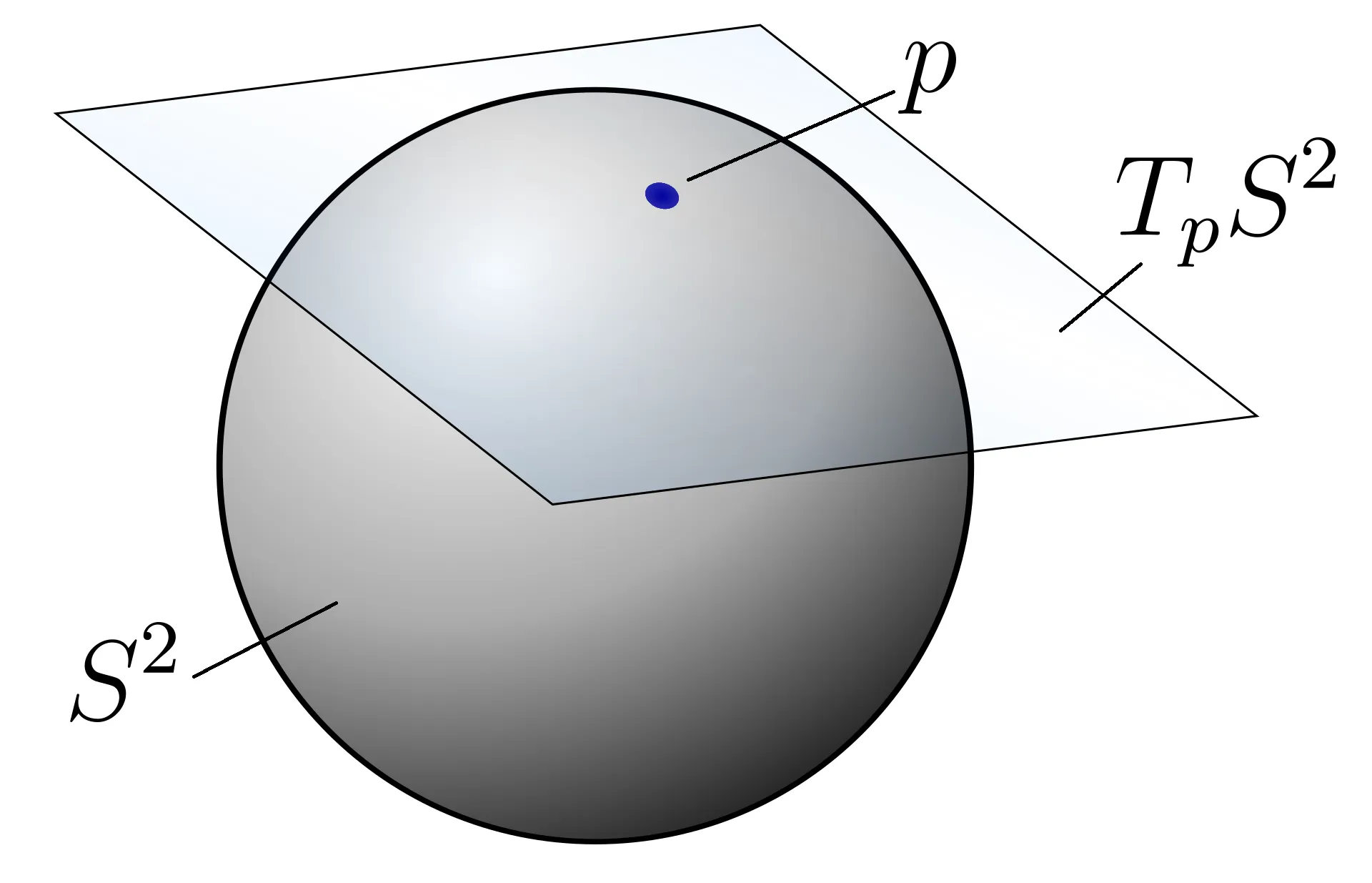 The obstacle in one picture: a distribution on a curved space cannot be described as it would be on a flat one. The tangent space at a point is the flat approximation available there, and only there.
A parallel line of work in control theory has been devoted to the distributional control of stochastic systems. It is now possible to control the whole distribution of trajectories rather than a single trajectory, under a variety of conditions and even subject to probabilistic constraints. That theory, though, is fully developed only for linear systems, and does not carry over to the non-Euclidean spaces in which systems on Lie groups live.
The objective of this project is to supply the missing theoretical foundation: control of distributions for systems evolving natively on Lie groups, including those coordinatized by hypercomplex numbers and, more generally, by Clifford algebras, as advanced astrodynamics applications require. The work is organized as three separate but closely aligned tasks. The first concerns modeling and the second control design; the third addresses numerical and experimental validation, so that the resulting theory is usable by practitioners rather than only provable.
Sponsors
This project is sponsored by AFOSR.
Selected Publications and Presentations
None listed yet.