Responsibility for the safe completion of a flight ultimately rests with the pilot-in-command. Especially during emergencies, this responsibility can be demanding due to the large number of tasks to which the pilot must attend, including: detecting and resolving failures in aircraft systems; continuing to monitor aircraft system health; coordinating with cabin crew, airline dispatchers and air traffic control; controlling the aircraft; and planning (and then following) a trajectory that will result in a safe landing. This inherent difficulty is compounded by a significant number of stressors, including physical danger, an uncomfortable physical environment (heat, smoke, noise, etc.), an overwhelming amount of information to consider, and the need to make decisions in a short period of time. In addition, the aircraft may have degraded performance and handling qualities, limiting the extent to which the pilot’s past experience is relevant to the present problem.
The aim of this project is to develop an intelligent system that would be able to assist/advise the pilot for the correct action to land the airplane safely in case of an on-board emergency. In contrast to current “strategic” planners (eg FMS) that use a low-fidelity model of the airplane and merely provide waypoint and altitude crossings, our ultimate goal is to provide an emergency generation architecture that will blend smoothly and seamlessly short-term actions with long-term optimization objectives.
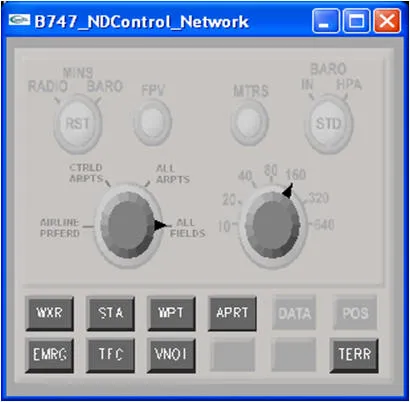
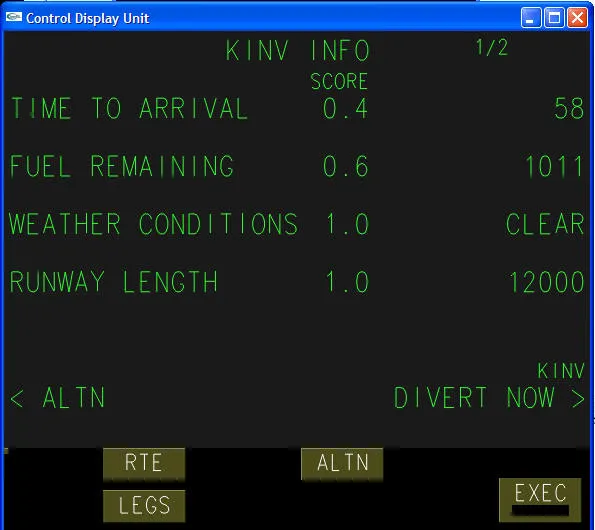
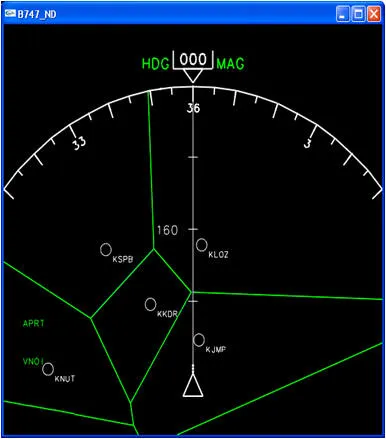 The APA interface: the control panel for selecting candidate airports (left), the scored comparison of the alternates (centre), and the navigation display showing which airport is reachable from where (right).
The proposed APA interface is based on a traditional (B-777) FMS system, with the addition of buttons that allow the pilot to (down)select the list of available airports to land. The list of the most promising airports is computed on-line by a trajectory optimization solver. For robustness, the initial screening uses an extension of the Dubins path problem in the three-dimensional space.
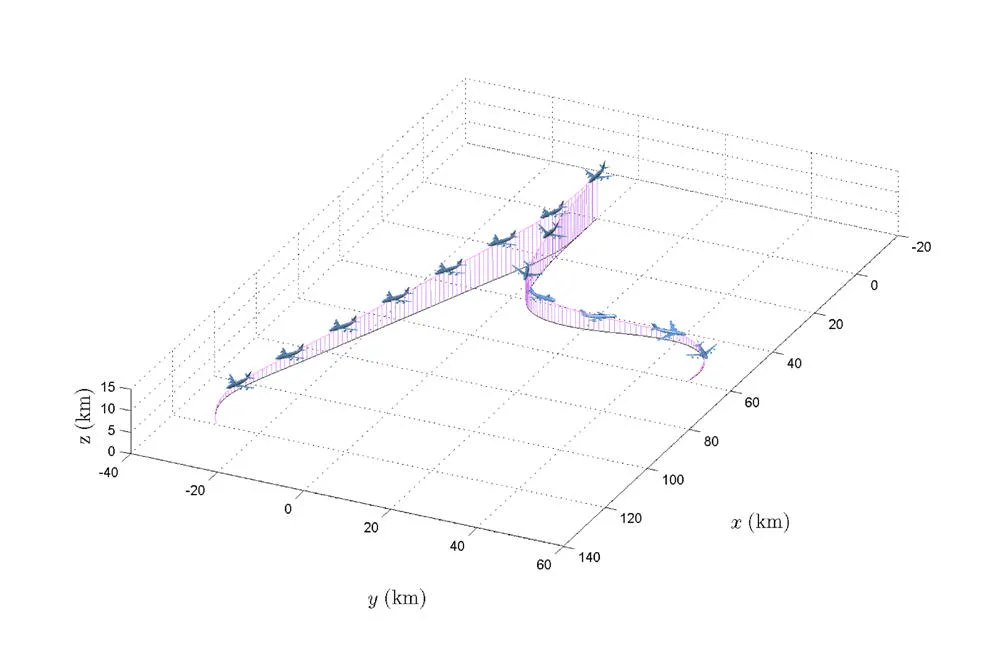
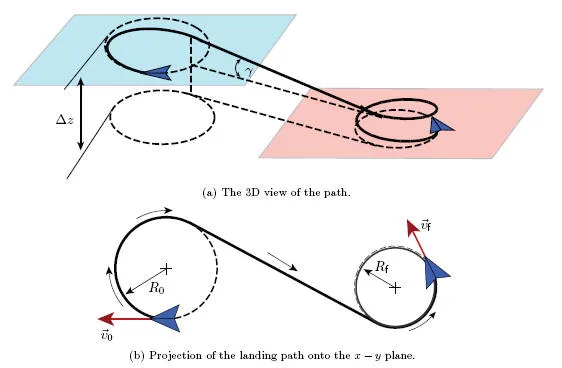 The three-dimensional Dubins-like descent used for the initial screening: a horizontal Dubins path lifted into a continuous descent (left), and its construction from two circular arcs and a connecting tangent (right).
The approach consists of the following tasks: First, we introduce a geometric framework for the generation of length-suboptimal, curvature-constrained, three-dimensional curves, which satisfy the following requirements: 1) the projection of the curve on the horizontal plane corresponds to a Dubins-like path, and 2) an aircraft traveling along this curve is descending continuously until it reaches its final destination. Subsequently, we assign a speed profile along the path that captures succinctly the motion constraints of the aircraft, thus inducing a time-parameterization of the geometric path. After this time parameterization is attached to the path, the time histories of the control inputs required so that the aircraft can traverse the geometric path with the assigned speed profile are computed through inverse dynamics. The resulting time-parameterized path (along with the control input time histories) can be fed as an initial guess into a numerical optimal control solver, such as DENMRA.
Sponsors
This project is funded by NASA.