Surveying missions to small celestial bodies still depend heavily on ground segment operations. Acquiring signal and telemetry windows, storing and downlinking large volumes of sensor data, and planning each maneuver from the ground all make these missions operationally expensive, and for targets in the asteroid belt the communication delays make tight monitoring impractical. This project, funded by NASA’s Early Stage Innovations program in collaboration with NASA Goddard Space Flight Center, asked how much of that work a spacecraft could do for itself.
The result was AstroSLAM, an autonomous navigation pipeline that localizes a spacecraft near an unknown small body using only imagery from its onboard cameras. AstroSLAM formulates the SLAM problem as an incrementally growing factor graph, which lets measurements of very different kinds — visual features, absolute orientation, ranging — be fused in one estimator, and incorporates a relative dynamics factor that links the spacecraft’s pose to the orbital motion it must be undergoing. Validated against archival Dawn imagery of Vesta, the pipeline held navigation error below 0.5% of the relative orbit radius and orientation error below 0.25 degrees.
Two further capabilities were built on that foundation. A shape reconstruction method carves away the space outside the target body using visibility constraints from the estimated landmark map, recovering surface meshes of Itokawa and Vesta to within 5% of ground truth. And AstroVision, a dataset of roughly 100,000 real images of 14 small bodies drawn from seven missions, was assembled to train and benchmark feature detection in this domain — where the harsh, collimated illumination and textureless surfaces defeat descriptors developed for terrestrial scenes.
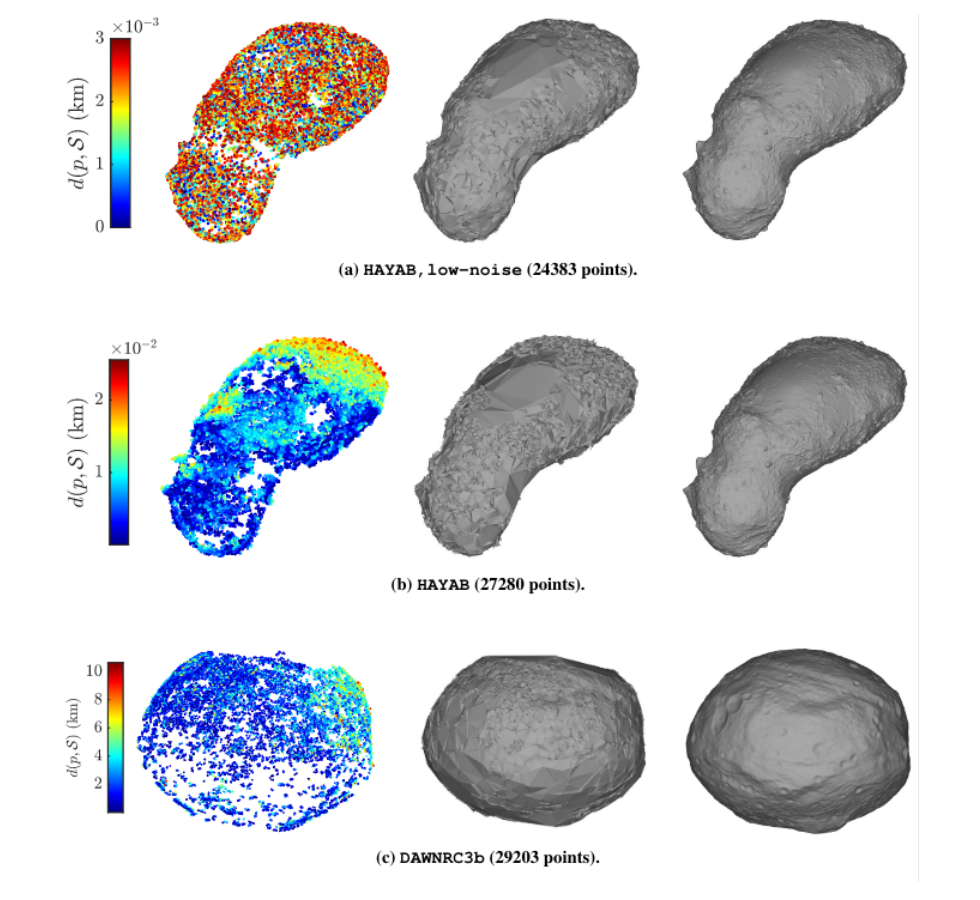 Reconstructed feature map (left), resulting shape model (middle), and ground truth (right), for Itokawa and Vesta.
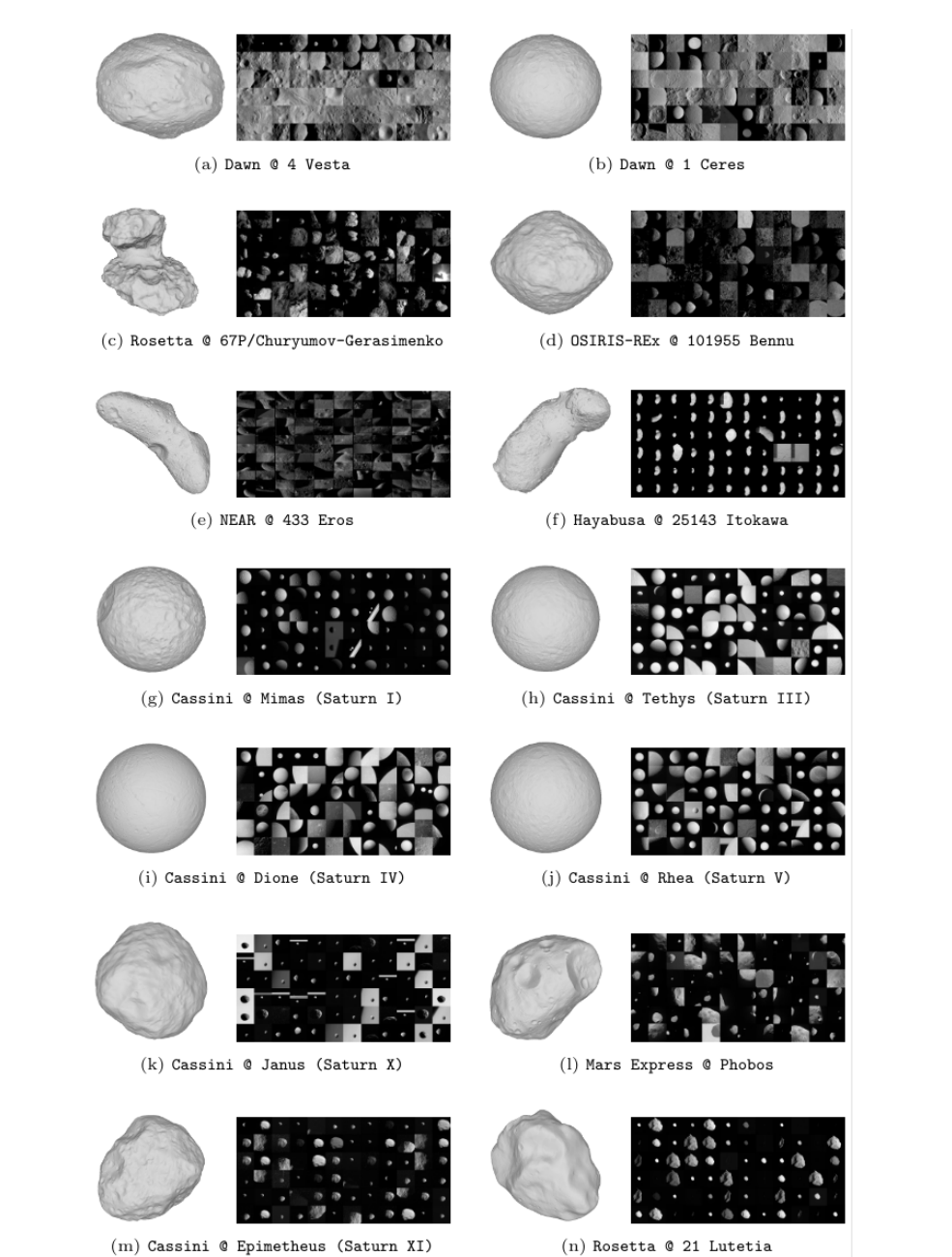 The AstroVision dataset: shape models and sample imagery for 14 small bodies across seven missions.
Selected Publications and Presentations
Driver, T., Dor, M., Skinner, K., and Tsiotras, P., “Shape Carving in Space: A Visual SLAM Approach to 3D Shape Reconstruction of a Small Celestial Body,” AIAA/AAS Astrodynamics Specialists Conference, South Lake Tahoe, CA, Aug. 9-13, 2020.
“Visual SLAM for Asteroid Relative Navigation,” with M. Dor, T. Driver, and K. Skinner, Workshop on AI for Space (AI4Space), Conference on Computer Vision and Pattern Recognition, June 19-25, 2021 (virtual).
Driver, T., and Tsiotras, P., “Deep Feature Detection and Description for Small Body Relative Navigation,” 3rd Space Imaging Workshop, Atlanta, GA, Oct. 10-12, 2022.
Driver, T., and Tsiotras, P., “Efficient Feature Description for Small Body Relative Navigation using Binary Convolutional Neural Networks,” 45th Annual AAS Guidance, Navigation and Control (GN&C) Conference, Breckenridge, CO, Feb. 2-8, 2023.
Driver, T., Vaughan, A., Cheng, Y., Ansar, A., Christian, J., and Tsiotras, P., “Keypoint-based Stereophotoclinometry for Characterizing and Navigating Small Bodies: A Factor Graph Approach,” AIAA SciTech, Orlando, FL, Jan. 8-12, 2024, AIAA Guidance, Navigation, and Control, Best Paper Award, AIAA Paper 2024-0513.
Driver, T., Vaughan, A., Cheng, Y., Ansar, A., Christian, J., and Tsiotras, P., “Keypoint-Based Stereophotoclinometry,” 4th Space Imaging Workshop, Atlanta, GA, Oct. 7-9, 2024.