BuzzRacer
BuzzRacer is a palm-sized autonomous vehicle platform for multi-agent racing, built to make experiments on physical hardware cheap enough to run routinely. A single car costs under $200. The chassis is a 1/28 scale Kyosho Mini-Z, 165 × 80 × 40 mm and 170 grams, reaching 3.5 m/s and about 1 g of lateral acceleration; a nondimensional Pi-group comparison puts it within an order of magnitude of a full-sized vehicle on every parameter, so the handling behavior it exhibits is representative rather than merely small.
Computation is deliberately moved off the car. The stock electronics are replaced by a custom board carrying an Arduino Nano 33 IoT and two H-bridges, which keeps the weight and therefore the vehicle dynamics of the original chassis while adding WiFi and a six-axis IMU. Because the steering circuitry is integrated into that board, the firmware measures the actual steering angle instead of commanding a black-box servo, which sharpens the vehicle model. State measurements come from an OptiTrack or Vicon tracking system and are streamed over a local network to one or more control computers, so a computationally heavy game-theoretic planner is not constrained by embedded hardware.
The repository holds the software stack as well as the hardware design. Modules for racetrack creation, dynamic simulation, planning, control, visualization and logging are selected through an XML configuration file, so moving a controller from simulation to a physical run is a configuration change rather than a code change. The dynamics use a single-track bicycle model with parameters identified by a UKF, an EKF supplies state derivatives in experiments, and artificial measurement noise can be injected to test robustness. The platform was used to benchmark MPPI, iLQR and their game-theoretic counterparts MPPI-IBR and iLQGame on a two-car racing game, where the controllers produced blocking and overtaking behavior of the kind human drivers use.
Reference
Z. Zhang and P. Tsiotras, “BuzzRacer: A Palm-sized Autonomous Vehicle Platform for Testing Multi-Agent Adversarial Decision-Making,” IEEE/RSJ International Conference on Intelligent Robots and Systems, Abu Dhabi, UAE, Oct. 13-17, 2024, pp. 8510-8515. doi:10.1109/IROS58592.2024.10802853 · PDF
The platform is also described on the Facilities page. It is used at Georgia Tech in a project-based robotics course as well as in research.
Visit the GitHub repository for the source code and hardware details.
Gallery
 sample_sim.gif
 sample_sim_multi.gif
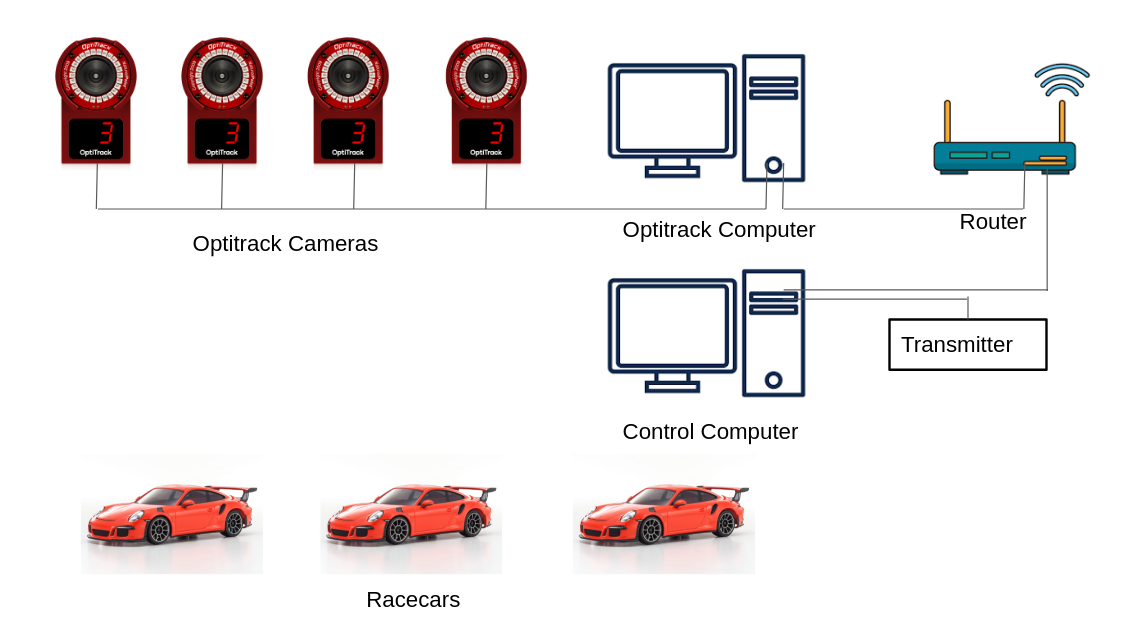 topology.png
 porsche_blue.png
 porsche_green.png